
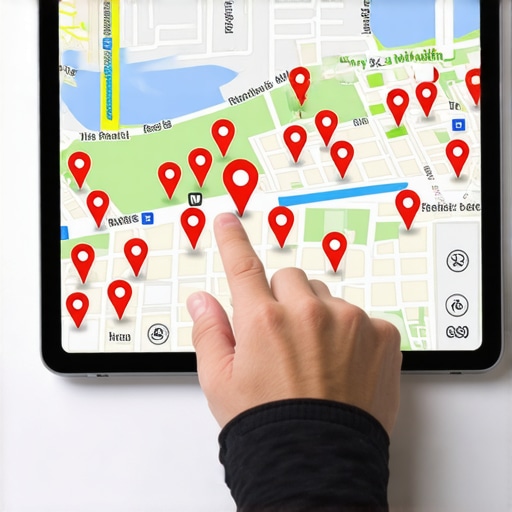
The sidewalk outside the plumber’s office smelled like wet concrete and exhaust. I stood there, phone in hand, looking at a digital ghost. On Google Maps, this business was dead. In reality, I could see the vans and the copper pipes. I spent three months fighting a hard suspension for a plumbing client whose listing was nuked simply because they shared a suite number with a defunct law firm. Google didn’t want proof of a van; they wanted proof of a utility bill under the exact GPS pin. This is the reality of the hyper-local layer. You can buy all the citations in the world, but if your proximity beacon is misaligned, you are invisible to the spatial database. Most business owners think a list of directory links will save them. They are wrong. Citations are just the noise in the background. To win, you must understand the microscopic math of coordinate salience.
The illusion of directory dominance
Citations are no longer the primary driver of Map Pack rankings because Google has transitioned to a proximity-weighted signal model. While directory consistency matters for baseline trust, the algorithm now prioritizes real-time user behavior, mobile device GPS data, and the mathematical distance between the searcher and the business centroid. If you find yourself wondering why your maps ranking dropped despite having a clean NAP profile, you are likely failing the proximity filter. I have seen businesses with five hundred citations get crushed by a competitor with ten reviews and a better location signal. The old ways of SEO are fading. We are now in the era of the Vicinity update, where the distance of the user is the ultimate gatekeeper. If your business is located on the edge of a city, no amount of Yellow Pages links will help you rank in the city center. You are fighting the physics of the map.
The mathematical weight of a three mile radius
The three mile radius is the standard visibility threshold for most service-based businesses in competitive urban environments. Google uses a spatial filter that reduces your visibility as the user moves away from your verified physical address to prevent map spam and ensure relevance for local searchers. This filter is why your business disappeared from mobile search the moment you drove across the town line. You need to understand the concept of centroid theory. Every city has a geographical center for every category. If you are too far from that center, you have to work twice as hard to prove relevance. This involves using the gmb toolkit to optimize for behavioral triggers. It is about more than just an address. It is about how many people click for driving directions while they are actually in their cars. It is about the frequency of check-ins. If Google does not see people actually visiting your location, they will doubt your address exists at all.
“Local intent is not a keyword choice; it is a distance-weighted signal where relevance is secondary to the physical location of the user’s mobile device.” – Map Search Fundamental
Local Authority Reading List
- https://gmbrankingdroppedhelp.com/the-emergency-checklist-for-gmb-profile-suspensions
- https://gmbrankingdroppedhelp.com/the-one-schema-error-that-makes-google-doubt-your-business-address
- https://gmbrankingdroppedhelp.com/3-questions-that-expose-a-fake-local-seo-expert-in-minutes
- https://gmbrankingdroppedhelp.com/why-your-business-is-invisible-outside-a-3-mile-radius
The forensic trace of a service area polygon
Service area polygons must be defined by actual historical job data rather than aspirational market reach to avoid triggering trust flags in the Google Business Profile algorithm. When a business claims a massive service area without corresponding location signals from user devices, Google often dampens their organic visibility. I once investigated a roofer who claimed the entire state. Their rankings were flat. We found the problem in their Local Services Ads bidding. There was a mismatch. To fix this, you need the strategy for restoring ranking that involves shrinking your service area to your actual footprint. Only then will the proximity engine trust you. Stop trying to be everywhere at once. Be dominant in your immediate neighborhood first. Use how to get more calls from google business profile toolkit strategies to focus on local justification triggers, such as reviews that mention your specific neighborhood by name.
Why your physical address is a liability
Physical addresses become a liability when they are associated with co-working spaces, virtual offices, or shared suites that have a history of spammy business registrations. Google maintains a database of suspicious buildings where multiple businesses have been suspended, leading to a guilt by association penalty for new listings. If you are struggling with a suspended business profile, the building itself might be the cause. I have seen entire office complexes blacklisted because a lead gen company registered fifty fake profiles there. You need a clean pin. This is why google business profile recovery service is often required to prove you are a legitimate entity with a real lease. Google wants to see the signage on the door. They want to see the lobby. If you cannot provide a video walk-through that matches your GPS coordinates exactly, you will never rank in the Map Pack. The algorithm is looking for the glitch in the storefront data.
“Businesses must be able to demonstrate physical presence at the location specified on their profile through permanent signage and the presence of staff during stated hours.” – GBP Merchant Guidelines
The hidden signal in your image metadata
Image metadata and the GPS coordinates embedded in photos taken by customers at your place of business provide more trust signal than a thousand directory citations. Google uses this data to verify that your business is a real destination where people actually spend time and money. This is a contrarian point that many agencies miss. While others tell you to buy more links, I tell you to get more photos from your customers. A photo taken on an iPhone with location services turned on is a gold mine for local SEO. It confirms your existence in a way a text review never can. If you are facing a sudden ranking drop, check your photo gallery. Are they all stock images? That is a trust killer. You need grainy, real-world photos of your shop. You need the images that smell like wet concrete and reality. This is how you win in the AI Overviews of 2026. The algorithm is looking for information gain, and real-world imagery provides it.
The forensic audit of local review sentiment
Review sentiment analysis now includes looking for local identifiers and spatial keywords that prove the reviewer was actually at the location when the review was written. Google identifies fake reviews by analyzing the IP address of the reviewer and the lack of historical movement data on their mobile device. If you want to fight review spam, you have to understand this forensic level of detail. A competitor dropping twenty 1-star reviews from a VPN is easy to spot if you know what to look for. We use gmb review and reputation management toolkit techniques to flag these profiles. The goal is to build a profile that is so geographically anchored that it becomes impossible to fake. Use step by step gmb ranking toolkit for beginners to start collecting reviews that mention your street name and your city. This creates a semantic connection between your brand and your coordinates that no national chain can replicate.
Restoring trust after a map blackout
Restoring trust after a total map blackout requires a complete audit of every technical signal, from your LocalBusiness schema to your mobile site speed and citation consistency. A single mismatched phone number in a secondary tier can be enough to trigger a manual review and a subsequent ranking crash. If your profile is verified but invisible, you likely have a conflict in your data layers. Perhaps you moved and didn’t update your local schema. Or maybe you have duplicate gmb listings that are cannibalizing your authority. You must be methodical. Use how to perform a diy seo audit to find the gaps. The pin moved, and you didn’t notice. But Google did. Every tiny error is a reason for the algorithm to doubt your business. In the world of local search, doubt is the same as death. You need to be the most certain entity in your zip code. Clean up the spammy links and focus on the signals that actually move the needle. Your map ranking is a reflection of your physical reality. Make it undeniable.