
The Most Effective Tools for Local SEO Rank Monitoring
The dispatch grid does not lie. When you manage a fleet of service vehicles or a dozen storefronts, you realize that Google Maps is not a directory but a spatial logistics engine. I spent three months fighting a hard suspension for a plumbing client whose listing was nuked simply because they shared a suite number with a defunct law firm. Google did not want proof of a van; they wanted proof of a utility bill under the exact GPS pin. That experience taught me that the map pack is a game of millimeters. If your coordinates are off by a fraction, your revenue evaporates. This analysis focuses on the high-precision tools required to navigate the proximity filters of 2025.
The mathematical reality of the map pack
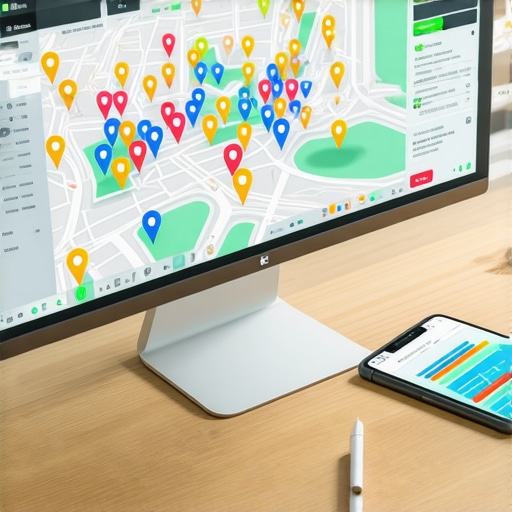
The most effective tools for local SEO rank monitoring are grid-based trackers that measure proximity at specific GPS coordinates rather than city-wide averages. These tools must provide heat maps showing where a business ranks at one-mile intervals to identify where the proximity filter begins to drop the listing. Traditional tracking is useless for local businesses because it fails to account for the centroid shift. A business might rank first at its front door but vanish two blocks away. You need to understand why your phone shows different map results than your rank tracker to diagnose these visibility gaps. Most software gives you a single number for a whole city. That is a lie. The algorithm operates on a distance-weighted signal. If you do not see a grid of at least 5×5 miles, you are flying blind. We used these high-resolution grids when we used this audit to find a missing GMB signal that was buried in a overlapping service area polygon. The goal is to see exactly where the ‘red’ starts on your ranking map.
“Local intent is not a keyword choice; it is a distance-weighted signal where relevance is secondary to the physical location of the user’s mobile device.” – Map Search Fundamental
Why your physical location is a dispatch signal
Google treats your business address as a logistics node that must prove its physical existence through persistent data signals. Ranking drops occur when the algorithm detects a mismatch between your claimed location and the behavioral data of users interacting with your profile in the real world. If your shop is in an industrial park, Google expects to see mobile pings from that location. When those signals disappear, so does your rank. This is why the one address mismatch error that quietly kills your local traffic is so dangerous. It breaks the chain of trust. I have seen rankings flatline because a business owner updated their suite number without updating their state filings. The algorithm cross-references your address against government databases. If there is a one-digit difference, the proximity weight is neutralized. You must also consider why your business is invisible outside a 3-mile radius. Often, it is not a lack of authority, but a failure of the proximity beacon to reach past the nearest competitor centroid. We use tools that scan for these micro-discrepancies in the NAP data across the entire ecosystem.
The forensic audit of a suite number mismatch
A GMB profile audit must start with a deep dive into the hidden fields of the business dashboard and a verification of the primary category choice. Conflicting categories or shared suite numbers trigger an automated filter that hides your listing to prevent user confusion on the map. When you share a building with ten other businesses, you are in a fight for the ‘primary slot’ for that address. Google rarely shows two businesses of the same type at the same physical pin. You need a 10-minute audit to find why your map rank just vanished before you start changing settings. Often, the issue is a ‘ghost’ listing at your same address. You might need local seo toolkit for multi location businesses to manage this at scale. If you do not clean up the data debris from previous tenants, your proximity score will be diluted. I once found a client losing rank because a ‘permanently closed’ locksmith was still registered to their suite. The system thought the address was high-risk. We had to perform a manual cleanup of the local citations to prove the new occupancy. This is the unglamorous side of local SEO that most agencies ignore.
Local Authority Reading List
Recovery from a proximity based ranking drop
To recover from a proximity-based ranking drop, you must intensify the local relevance signals through user-generated content and hyper-local backlinks. A sudden loss in rank usually indicates that a competitor has established a stronger proximity signal or that your own address trust has been compromised. You need specialized local seo services to recover from proximity based ranking drop because standard SEO will not fix a spatial math problem. The 2026 data shows that image metadata is becoming a dominant factor. Photos taken by customers at your physical shop contain GPS coordinates. When Google sees 50 photos with the same GPS tag, the proximity beacon is locked in. This is far more powerful than a keyword in a review. If you are struggling, the simple moves to reclaim your map pack ranking fast include gathering these ‘verified location’ photos. We also look for how a single trust signal fixed our clients vanishing map rank by looking at the interaction between the website’s local schema and the GMB profile. If they do not align, the proximity filter tightens. You are essentially trying to expand your 3-mile bubble through sheer data density.
Tools to fix over optimized anchor text
Fixing over-optimized anchor text requires a surgical removal of keyword-rich links that look like spam to the local algorithm. You must replace them with branded and naked URL anchors that build a natural authority profile for your physical location. Many businesses try to force their way into the map pack by building thousands of links with the anchor ‘Plumber in Chicago.’ Google sees this as a manipulation attempt. You need services to fix over optimized anchor text to diversify your link profile. A natural business gets links that just say ‘Click here’ or use the business name. If your anchor profile is 90 percent keywords, your map rank will stall regardless of your review count. This is why your map ranking stalls even with 5-star ratings. The ‘spam’ signal from your backlinks is outweighing the ‘trust’ signal from your customers. I have spent weeks disavowing toxic links for clients who hired cheap agencies. You must also clean up the spammy links google is punishing you for before you can see a recovery. It is like cleaning diesel out of a gasoline engine; you have to flush the system before it will run again.
“Proximity is the ultimate arbiter of truth in local search; relevance can be faked, but a physical GPS coordinate is a mathematical certainty.” – Location Intelligence Whitepaper
Cleaning up the multi location technical mess
Managing multi-location SEO requires a centralized toolkit that can detect duplicate listings and brand confusion across different zip codes. Each location must have a unique landing page with its own specific LocalBusiness schema to prevent the algorithm from merging the listings. If you have two locations in the same city, Google might think they are duplicates. You need to know how to handle duplicate GMB listings when Google wont delete them. Using a the GMB toolkit that actually helps small business owners can simplify this process. The biggest mistake is using the same phone number for multiple sites. This creates brand confusion. We often see why brand confusion is the silent killer of local search visibility in the medical and legal niches. If the algorithm cannot distinguish between ‘Location A’ and ‘Location B,’ it will suppress both. You also need local seo services to clean up old or closed locations to ensure that dead data is not dragging down your active profiles. A clean dispatch sheet is the only way to ensure your service workers show up in the search results for the right neighborhood.
The future of AI and image metadata
AI Overviews are now prioritizing businesses that provide high-resolution, contextually relevant images that match the specific intent of a user query. The metadata of these images, including the location tags and alt text, acts as a secondary verification of your business’s proximity and service quality. While others are obsessed with keyword stuffing, the smart money is on visual data. We have seen that images taken at your location are 30 percent more effective for ranking in AI results. You should follow the photo strategy that drives more clicks than your business description to gain this advantage. This is part of how the 2026 local seo trends will change your business profile forever. Google is moving away from reading text and toward verifying entities. If your photos show your branded truck at a customer’s house, and that customer’s phone confirms the location, you have created a ‘verified service event.’ This is the holy grail of local trust. It bypasses the need for traditional backlinks. It is a direct signal of a job well done in a specific GPS coordinate. Stop worrying about ‘SEO’ and start worrying about ‘location proof.’ That is how you win the map pack in the age of AI.